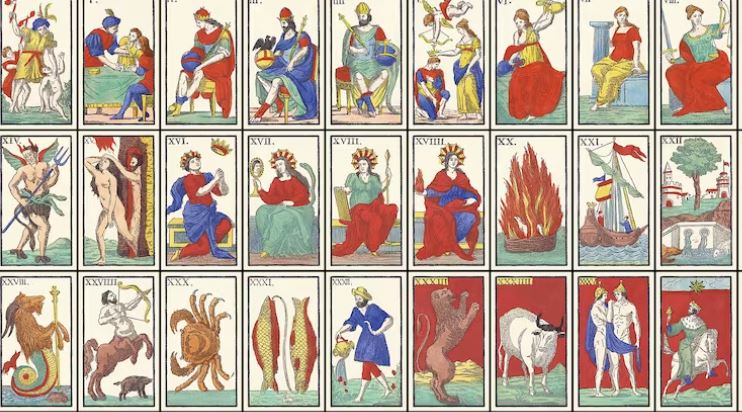

Imagery in playing cards is hundreds of years old – in some cases with almost no change. I explore why images change over time or resonate through it.
This is an ongoing project where I contemplate the imagery in early tarot decks and unravel the meaning and either replicate or translate it with an inevitably modern perspective. I choose material objects and assemble compositions which resonate with the meaning of the images held within the cards, and painting sight-size classical trompe l’oeil still life representations.
View the completed paintings so far in the gallery.
I often reference the Minchiate Tarocchi – a tarot deck printed in Florence (16th century) and thought to be one of the earliest examples of a tarot card deck.
This deck was created and published as a game, with tricks and trumps, with layers of meaining hidden in plain sight. In the original game the trump cards had identities and are what we know today as the major arcana. The minor arcana or suits didn’t appear to develop their idenities beyond gaming numbers until the suit-based decks were used for fortune telling.
The minor arcana in a tarot deck directly corresponds to our 4 suits (though the names of the suits change by region and time).
I like to think its subject and imagery helped make the games played with a tarot deck popular, to the point that it is the meaning of the images that has endured over the game itself. Perhaps in the same way games today are popular when they include dragons, film references, or even anthropomorphic sushi even though these are often arbitary to the mechanics of play – but provide an immersive and engaging experience for players.



 AFJW Creations